Personal notes and projects

A few notes on how I tend to think and work.

I made this page mostly for fun: a collection of personality-test results, source material and a few projects I have been working on. It is only one incomplete view of me, but it gives the ideas a little more context.

A personal page, made for fun.
01 — Overview

A brief overview

Different tests use different labels. The sections below explain what each label is intended to describe and where the results overlap.

Repeated pattern

Often analytical

96% Thinking, Ti 43.4, and DISC C 33 all point to logic-first processing.

Behavioural result

Attention follows perceived value

Pymetrics flags a bias toward tasks with the highest expected return for time invested.

Working pattern

Strong single-task focus

Strong single-task concentration; weaker fit for constant context switching and fragmented work.

Mixed pattern

Direct style, generally cooperative intent

I am not naturally inclined to smooth over every disagreement, while the behavioural results suggest I usually approach others with trust and fairness.

02 — Results

Results and what each label means

Each framework describes a different slice of behaviour. The definitions explain the intended meaning of the scores rather than treating any label as absolute.

16-type result

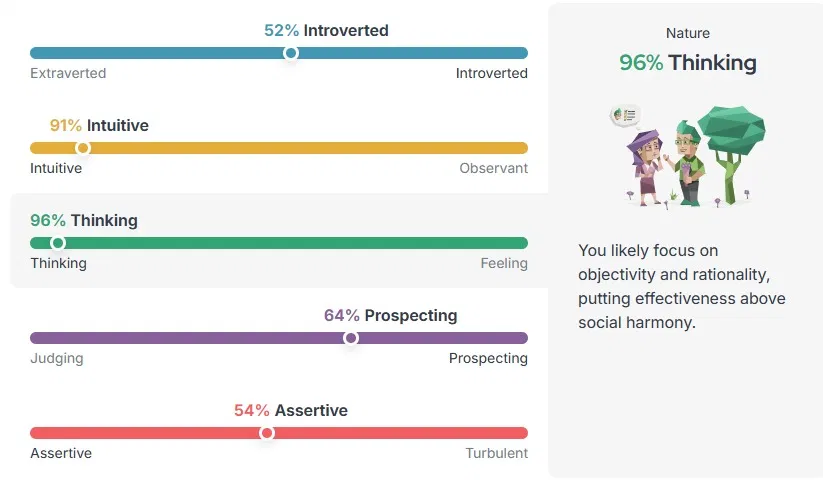
Near-balanced introversion; extreme intuition and thinking.

INTP-A
Introverted
52%
Intuitive
91%
Thinking
96%
Prospecting
64%
Assertive
54%
I · Introverted — 52%Usually recharges through internal reflection and smaller-scale interaction. This score is almost balanced, so it should not be read as strongly introverted.
N · Intuitive — 91%Prefers patterns, possibilities and underlying concepts over staying only with concrete details or established procedure.
T · Thinking — 96%Tends to judge ideas through logic, consistency and consequences before considering social harmony or emotional comfort.
P · Prospecting — 64%More comfortable keeping options open and adapting as information changes than locking everything into a fixed plan early.
A · Assertive — 54%Slightly more self-assured and less stress-reactive than turbulent, but the score is close enough to the midpoint that both styles may appear.
More defensible shorthand: xNTP, leaning INTP. The 52% I score is too close to the midpoint to treat introversion as absolute.

DISC

Precision first, stability second.

Self-report
21D · Dominance
20I · Influence
26S · Steadiness
33C · Conscientiousness
D · Dominance — 21How readily someone takes control, challenges obstacles and prioritises speed or results.
I · Influence — 20How strongly someone relies on enthusiasm, sociability and persuasion to move people.
S · Steadiness — 26Preference for patience, predictability, cooperation and a stable pace.
C · Conscientiousness — 33Preference for accuracy, evidence, standards and careful evaluation before accepting a conclusion.
The order C > S > D > I suggests precision first, stability second, with less reliance on social enthusiasm. C does not mean being organised in every area; here it fits selective precision on work considered important.

Cognitive-function battery

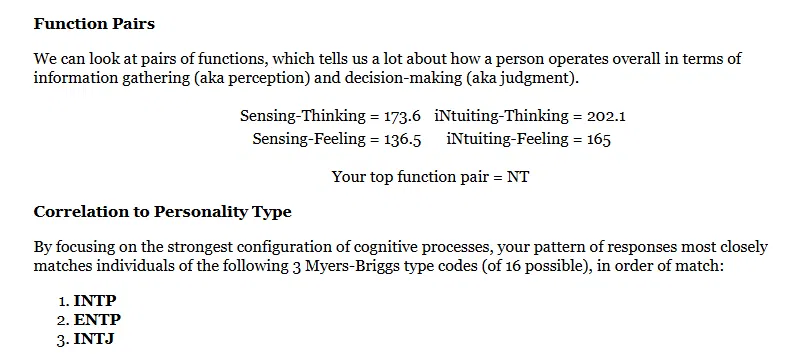
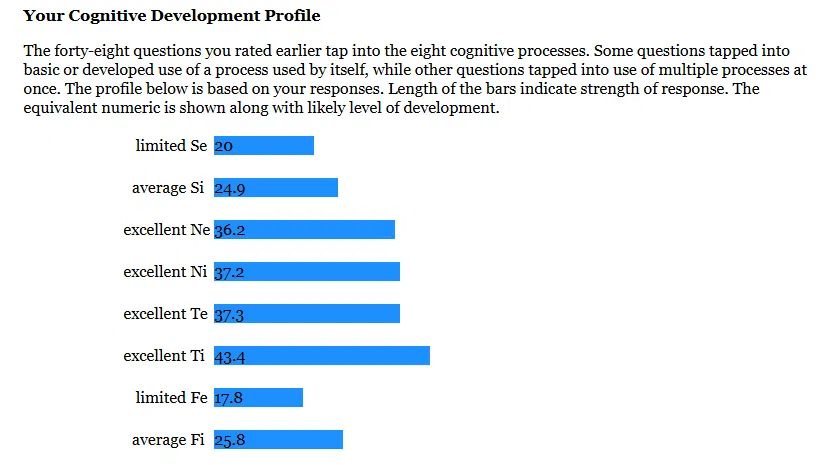
Top function pair: NT. Closest type matches: INTP → ENTP → INTJ.

Strongest signal: Ti
Ti
43.4
Te
37.3
Ni
37.2
Ne
36.2
Fi
25.8
Si
24.9
Se
20.0
Fe
17.8
What the eight function abbreviations mean
Ti · Introverted ThinkingBuilds an internally consistent model and tests whether the reasoning holds together.
Te · Extraverted ThinkingOrganises resources around measurable outcomes, execution and external efficiency.
Ni · Introverted IntuitionCondenses information into a likely underlying pattern or long-range implication.
Ne · Extraverted IntuitionGenerates alternatives, connections and multiple possible ways a situation could develop.
Fi · Introverted FeelingChecks decisions against personal values, authenticity and internal emotional alignment.
Si · Introverted SensingCompares the present with past experience, familiar methods and remembered detail.
Se · Extraverted SensingResponds directly to immediate sensory information, action and what is happening now.
Fe · Extraverted FeelingTracks group atmosphere, interpersonal expectations and what maintains social harmony.

Enneagram result

A motivation-oriented framework rather than an ability test.

5w4
Core type 5 · InvestigatorMotivated by understanding, competence, autonomy and conserving time or energy. Often prefers to observe and master a system before acting.
Wing 4 · Individualist influenceAdds a preference for originality, personal meaning and a precise identity rather than a purely conventional or utilitarian answer.
5w4 combinedUsually describes someone who wants both a rigorous explanation and an answer that feels independently reasoned rather than copied from consensus.
Likely watch-outCan overprotect time, remain in analysis too long or disengage from tasks that feel ordinary, socially performative or low-value.
This result describes a proposed motivation pattern; it does not measure intelligence, character or capability.

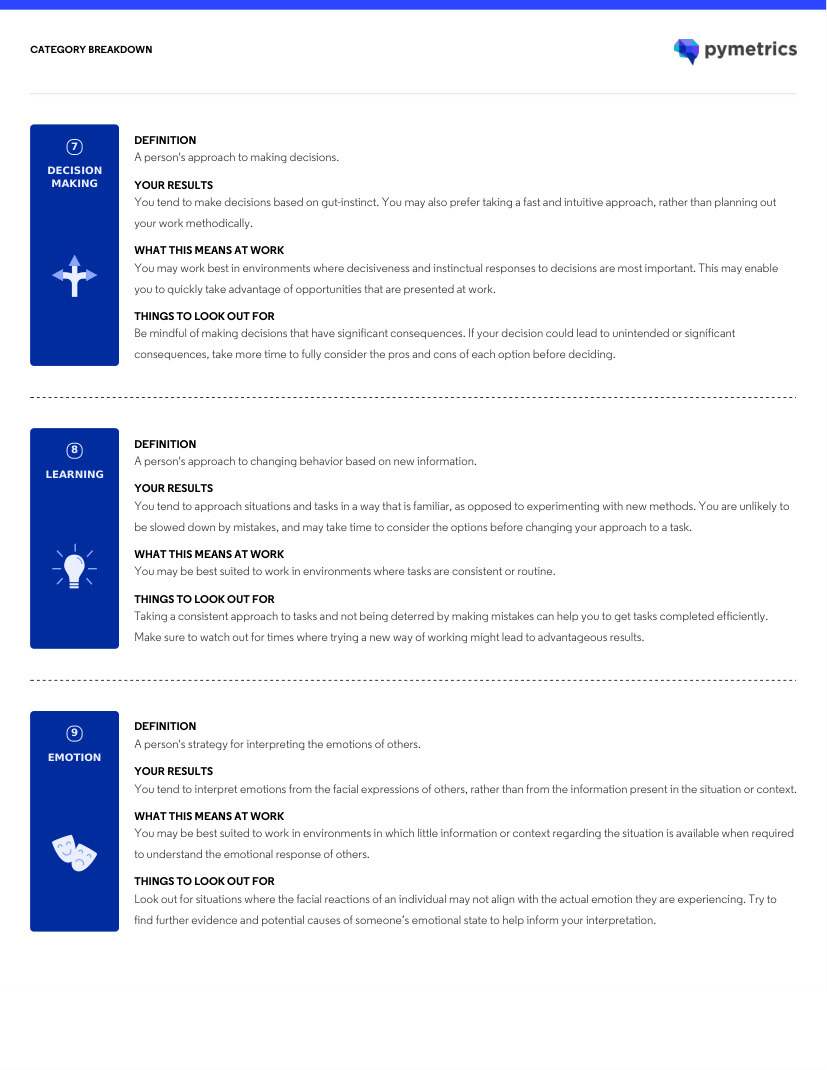
Pymetrics behavioural profile

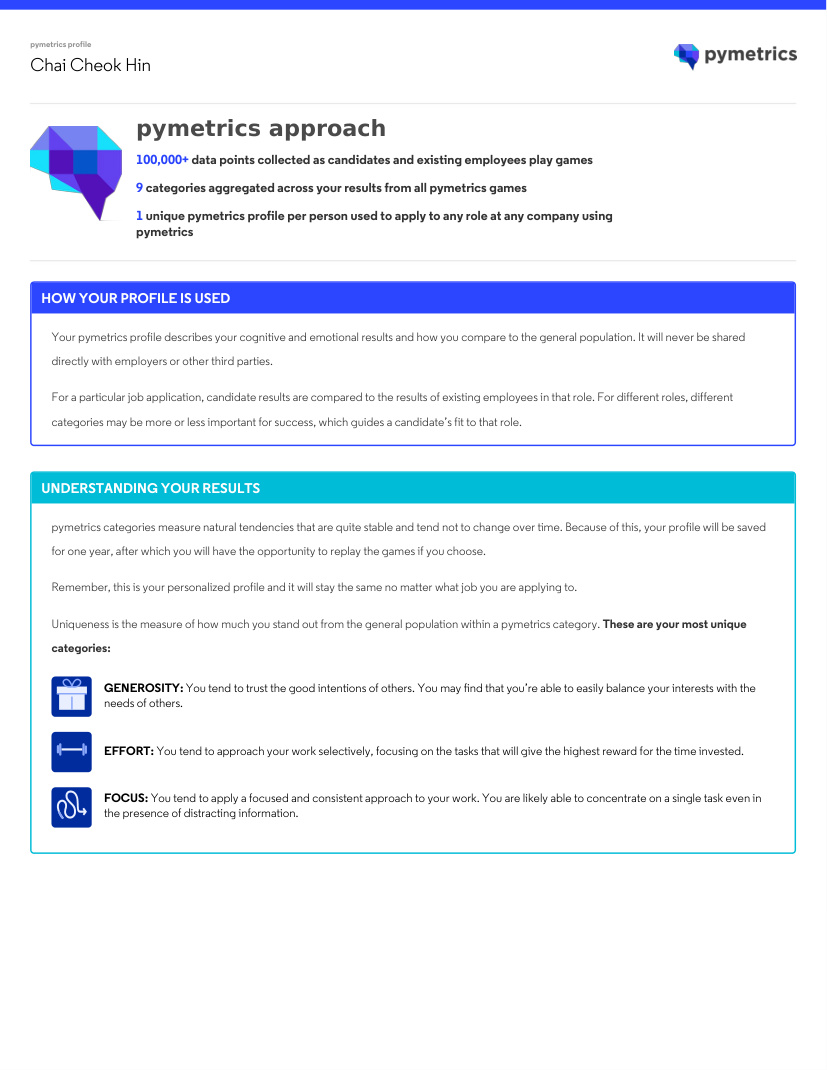
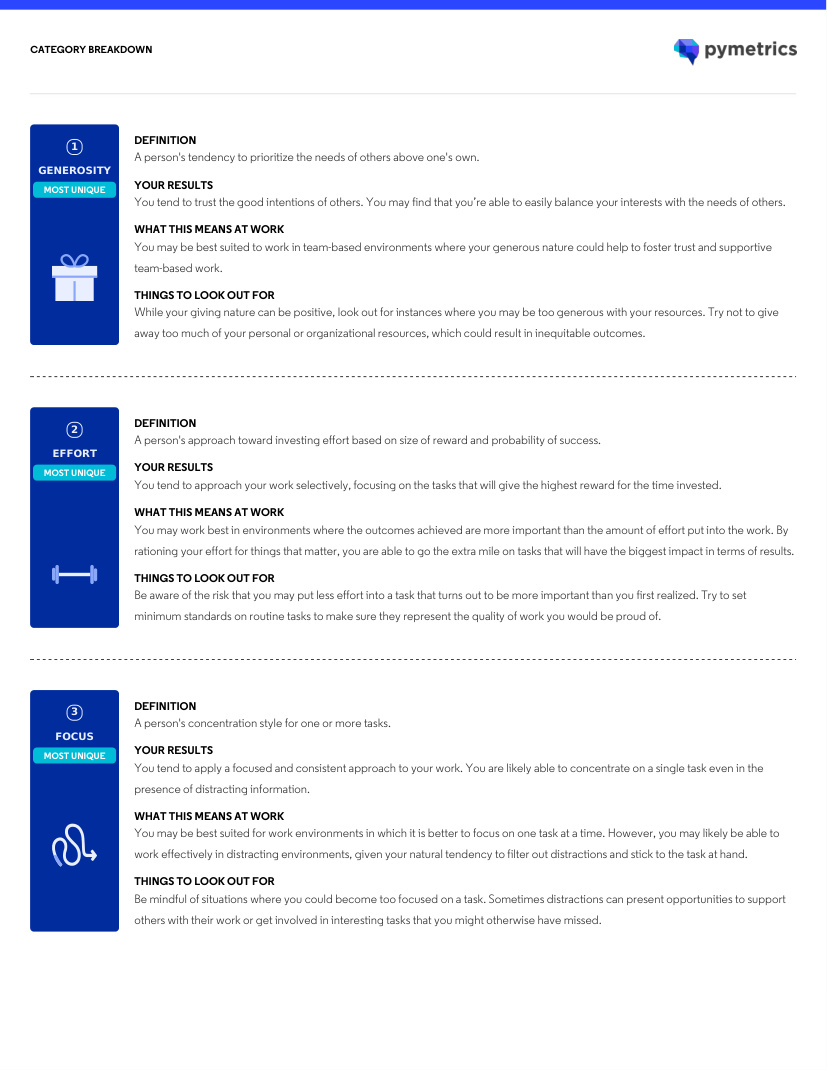
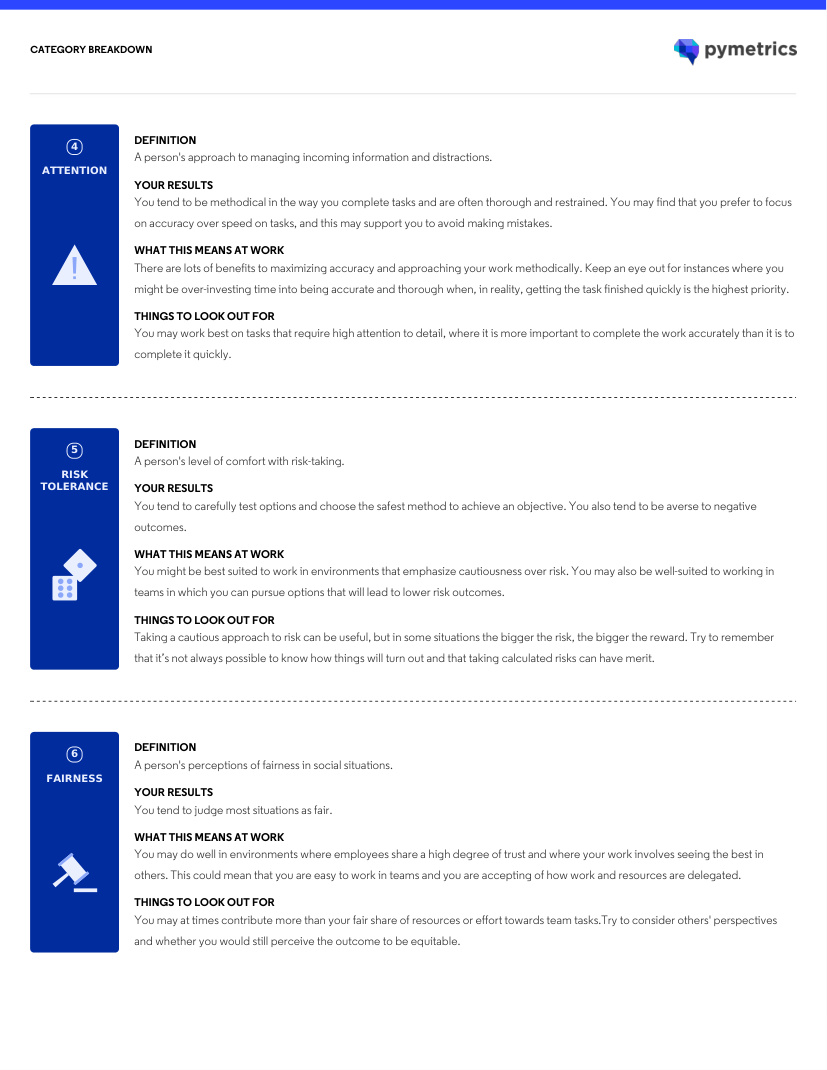
Nine game-derived categories. Generosity, effort and focus were marked as the most distinctive.

Behavioural
01

Generosity

Tends to trust good intentions and balance personal interests with other people’s needs.

02

Effort

Allocates effort selectively toward tasks with the strongest expected return for time invested.

03

Focus

Maintains narrow, consistent concentration and filters distracting information effectively.

04

Attention

Methodical and restrained; generally prioritises accuracy over speed.

05

Risk tolerance

Tests options carefully and usually prefers the safest route to the objective.

06

Fairness

Usually perceives situations as fair and is relatively trusting of how work and resources are allocated.

07

Decision-making

Often chooses quickly through instinct before applying deeper verification when stakes justify it.

08

Learning

Initially favours familiar methods and changes approach after considering new evidence rather than immediately experimenting.

09

Emotion

Reads emotion heavily from facial expression, with a need to cross-check situational context.

Belbin team roles

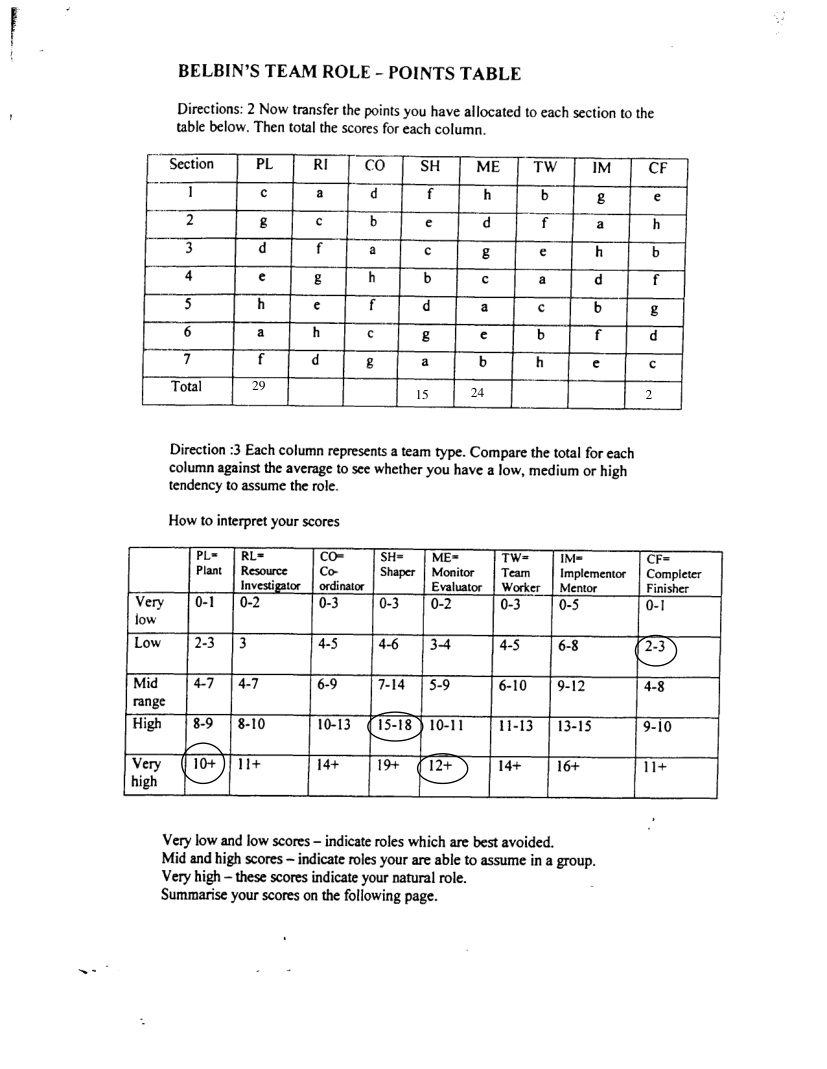
Scored using the standard 10-points-per-section method.

Team roles
Plant
29
Monitor Evaluator
24
Shaper
15
Completer-Finisher
2
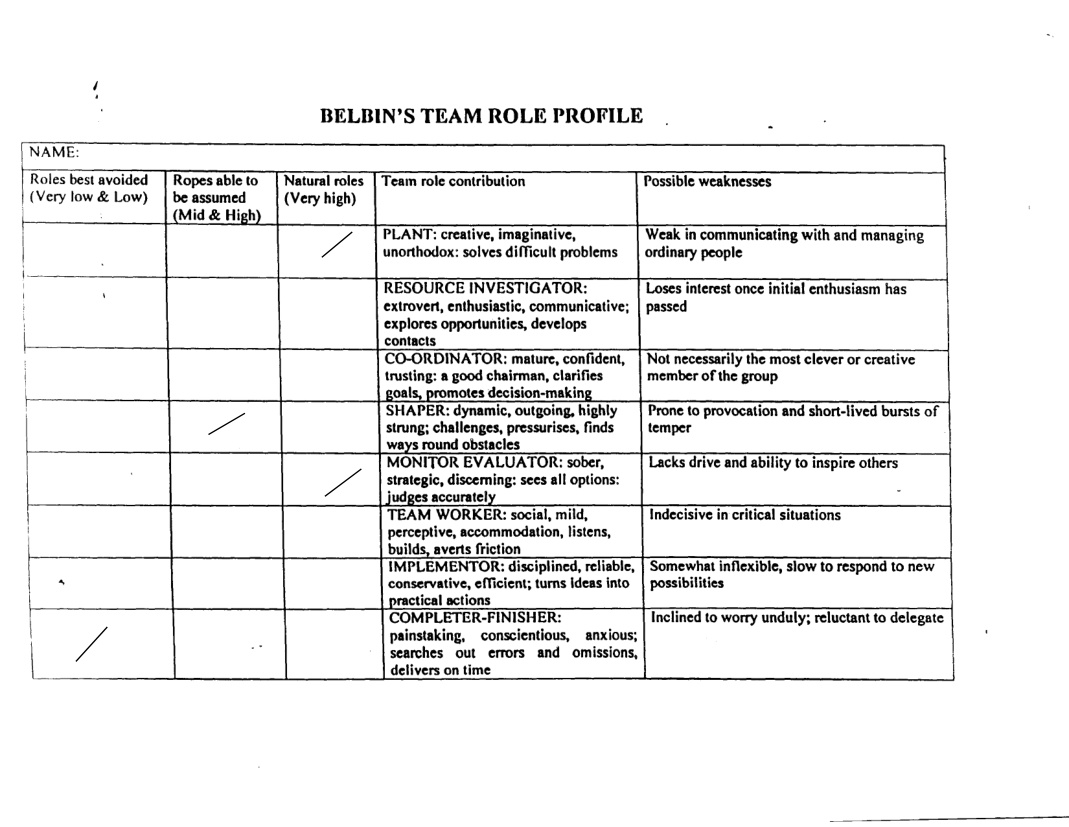
Plant · naturalContributes original ideas, reframes difficult problems and explores less obvious solutions. Possible downside: ideas may be harder to communicate or may outrun practical detail.
Monitor Evaluator · naturalCompares options calmly, notices weak reasoning and judges proposals on evidence rather than enthusiasm. Possible downside: can appear detached or slow momentum while evaluating.
Shaper · availableCan create urgency, challenge delay and push a group through obstacles when action is needed. Possible downside: direct pressure can read as impatience.
Natural means the role is likely to appear spontaneously. Available means it can be used when the situation calls for it, but it is less automatic. Method: 10 points distributed within each section; values reproduced from the uploaded transfer table.

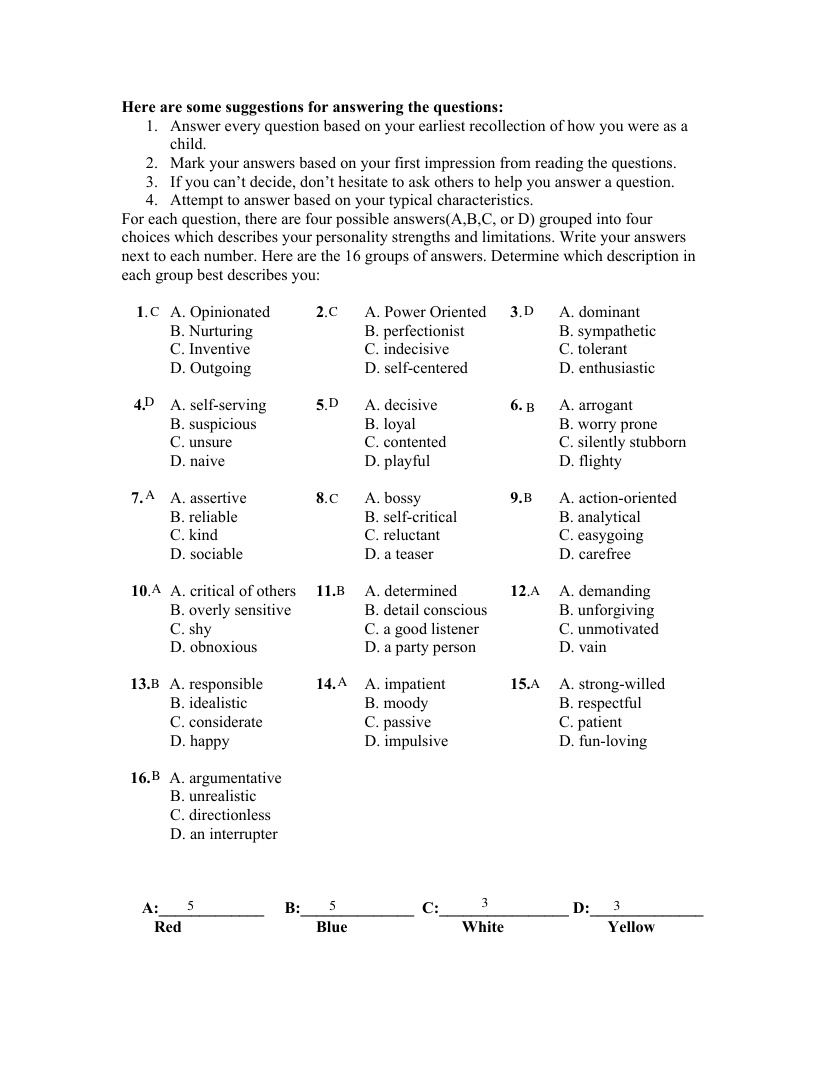
Four-colour test

A 16-item colour-based personality exercise.

16 items
5Red
5Blue
3White
3Yellow
Red · 5Direct, decisive, action-oriented and willing to challenge or take control.
Blue · 5Analytical, detail-conscious, quality-focused and more comfortable with a reasoned answer.
White · 3Patient, accommodating, calm and less inclined to force movement or conflict.
Yellow · 3Sociable, spontaneous, expressive and energised by interaction or novelty.
Result: Red–Blue tie. The test gives equal weight to pushing for movement and checking whether the solution is sound. In practice, that can look like directness followed by scrutiny: move the issue forward, but do not accept a weak answer merely for speed.
03 — Synthesis

What it probably means in plain English

Across the tests, a recurring pattern is curiosity about systems, preference for clear reasoning and stronger focus when the purpose of the work is visible.

01 / MODEL

I usually want to understand the system

I tend to learn more comfortably when I can see the mechanism beneath a process rather than memorising a sequence without context.

Ti 43.4 · Ne/Ni excellent · Plant 29
02 / PRIORITY

I tend to prioritise by expected value

Work that appears important or consequential receives more attention. The risk is underestimating routine tasks whose value is less obvious.

Pymetrics effort · Enneagram 5 pattern
03 / QUALITY

I value accuracy, but can overdo it

Methodical checking can reduce avoidable errors. The corresponding risk is spending too long polishing something that was already good enough.

Pymetrics attention · DISC C 33
04 / DISCUSSION

I am more comfortable testing an idea than smoothing over disagreement

I tend to question weak reasoning directly. That can be useful, but the wording and timing still need care.

Shaper 15 · Fe 17.8 · Thinking 96%

Analytical, yet fast and intuitive

Pymetrics reports gut-led decisions. Likely pattern: rapid initial selection, followed by detailed verification when stakes justify it.

Direct communication, alongside trusting results

The tests suggest I may communicate directly while still tending to assume good intent and view situations as broadly fair.

Novel ideas, familiar execution

Strong ideation coexists with a preference for proven methods once execution begins. Exploration and implementation operate differently.

04 — Working preferences

A few working preferences

These are patterns I have noticed in myself, not instructions for anyone else.

Helpful conditions

  • A clear outcome and freedom over method.
  • Complex problems with measurable consequences.
  • Long, protected blocks for single-task work.
  • Permission to challenge the premise, not only execute it.
  • A minimum standard for routine tasks, then aggressive prioritisation.

Things I need to watch

  • Misclassifying an uninteresting task as unimportant.
  • Over-analysing reversible decisions.
  • Letting blunt phrasing obscure fair intent.
  • Missing contextual emotional information by relying on facial cues.
  • Staying with a familiar method after evidence supports a better one.
05 — Projects

Projects and working prototypes

I like automating mundane steps and experimenting with small productivity and learning projects. The previews below are genericised versions of the uploaded tools and design documents, using fictional data and simplified interactions so the ideas are easy to explore.

pipeline simulation
Long recording folder
WAV · M4A · MP3
1 · compress to mono MP3
2 · split large files
3 · fast transcription
4 · quality fallback
5 · save text + segments
Audio workflow

Long-recording transcription studio

A local interface for processing large recordings without forcing the browser to upload the entire raw file. It compresses and splits audio, uses a fast transcription model first, retries low-confidence chunks with a stronger model and preserves segment timestamps.

  • Folder-path mode for very large recordings
  • Compression and chunking before API upload
  • Quality check with automatic model fallback
  • Transcript plus timestamped segments JSON
  • Optional speaker diarisation when configured
FOLDER MODE · FFMPEG · CHUNKING · FALLBACK · TIMESTAMPS
content detection preview
Detected input
Provenance-aware outputmodel: example-modelmode: deep
discovery-pack_by-model_deep
Learning audio

Audio learning studio

A local studio that accepts structured knowledge atoms, quiz items or dialogue scripts, detects the content type and sends it through the appropriate audio-generation path. It also keeps provenance and naming metadata attached to the output.

  • Detect atoms, item packs or voice scripts
  • Auto-read model and generation metadata
  • Preview consistent output names before rendering
  • Preserve provenance alongside generated audio
CONTENT DETECTION · AUDIO RENDERING · NAMING · PROVENANCE
routing logic preview
Next best action3 options · tap-only · under 30 seconds · consequence-focused feedback
Decision engine

Assessment routing engine

A deterministic framework that maps a concept to a suitable practice format based on what the learner must do in the real world. The later version narrows the MVP to tap-only formats and short completion times.

  • Routes facts, processes, judgments and conversation moves
  • Adjusts format by difficulty
  • Prefers two or three options for mobile use
  • Keeps the full item under roughly 30 seconds
V1 → V1.1 · ROUTING · TAP-ONLY · DIFFICULTY · FEEDBACK
before / after preview
Weak itemWhat is impact expansion?A definition question
Improved itemBuyer: “We just handle it manually.” What should the rep ask next?Ask what the manual workaround costs
Design system

Question-design rules

A versioned set of rules for producing short sales-judgment questions that feel closer to real calls than to textbook quizzes. The later version adds compressed buyer language and commercial-safe labels.

  • Test application rather than isolated recall
  • Use one clear decision point
  • Keep context necessary and distractors plausible
  • Prefer two or three parallel options
  • Avoid trivia, trick wording and corporate LMS language
V1 → V1.1 · COMPRESSED REALISM · PLAUSIBLE DISTRACTORS
generated item preview
Concept atomAfter a buyer names a mild pain, explore the business impact before pitching.
Buyer: “It is annoying, but we manage.” What should the rep ask next?
Generation prompt

Tap-based practice-item generator

A structured generation prompt that turns sales notes, playbooks or transcripts into short practice items. It extracts the smallest transferable decision rule, selects a tap-based format and uses generic public labels rather than source-specific framework names.

  • Extract a compact concept atom
  • Choose a suitable assessment format
  • Create original scenarios and plausible alternatives
  • Optimise for low reading effort and real-call transfer
  • Keep labels reusable for future commercial use
CONCEPT ATOMS · FORMAT MIX · GENERIC LABELS · SCENARIO VARIATION
Uploaded components represented here: prospect tracker; sales leak diagnostic; transcription studio v4; audio learning studio v9; question-design rules v1 and v1.1; assessment engine v1 and v1.1; and generator prompt v3.2. Earlier and later versions are grouped as one evolving project where they serve the same purpose.
06 — Source material

Original source docs

Open any image to view the original readout. The summaries above are my interpretation; the source material is included for context.
How to read this page

This is a for-fun snapshot rather than a complete account of my personality. The source material is included so the summaries can be read alongside the original results.

6 / 80
Copied